The Student Revolt in France Spreads
:Moving Forward with Rage and Solidarity

October 17 marked one of the fiercest days of mass protest in recent French history. Scenes of ferocious resistance unfolded throughout the day, not only in Paris but in Bordeaux, Dijon, Marseille, Nancy, and dozens of other cities across the country. Some observers have described the day’s events as more explosive than the Yellow Vest movement of 2018-19—and the rebellion shows no sign of slowing.
How did we get here? Courageous high school students have been protesting for weeks against abominable conditions in schools, the rise of the extreme right, and the bleak prospects they face in a world dominated by technocrats and tech barons. Alongside growing anti-government protests from Albania, Italy, Spain, and beyond in recent days, the French student rebellions may herald the emergence of a new wave of global struggle.
In this article, our correspondent from Paris explains the context behind the youth rebellion, tracks the movement’s growth over the two weeks leading up to October 17 and the government’s failed attempts to repress or to pacify it, and clarifies the stakes moving forward.
Stay tuned for a full report on the uprising of October 17 and the ongoing rebellions across France and beyond.
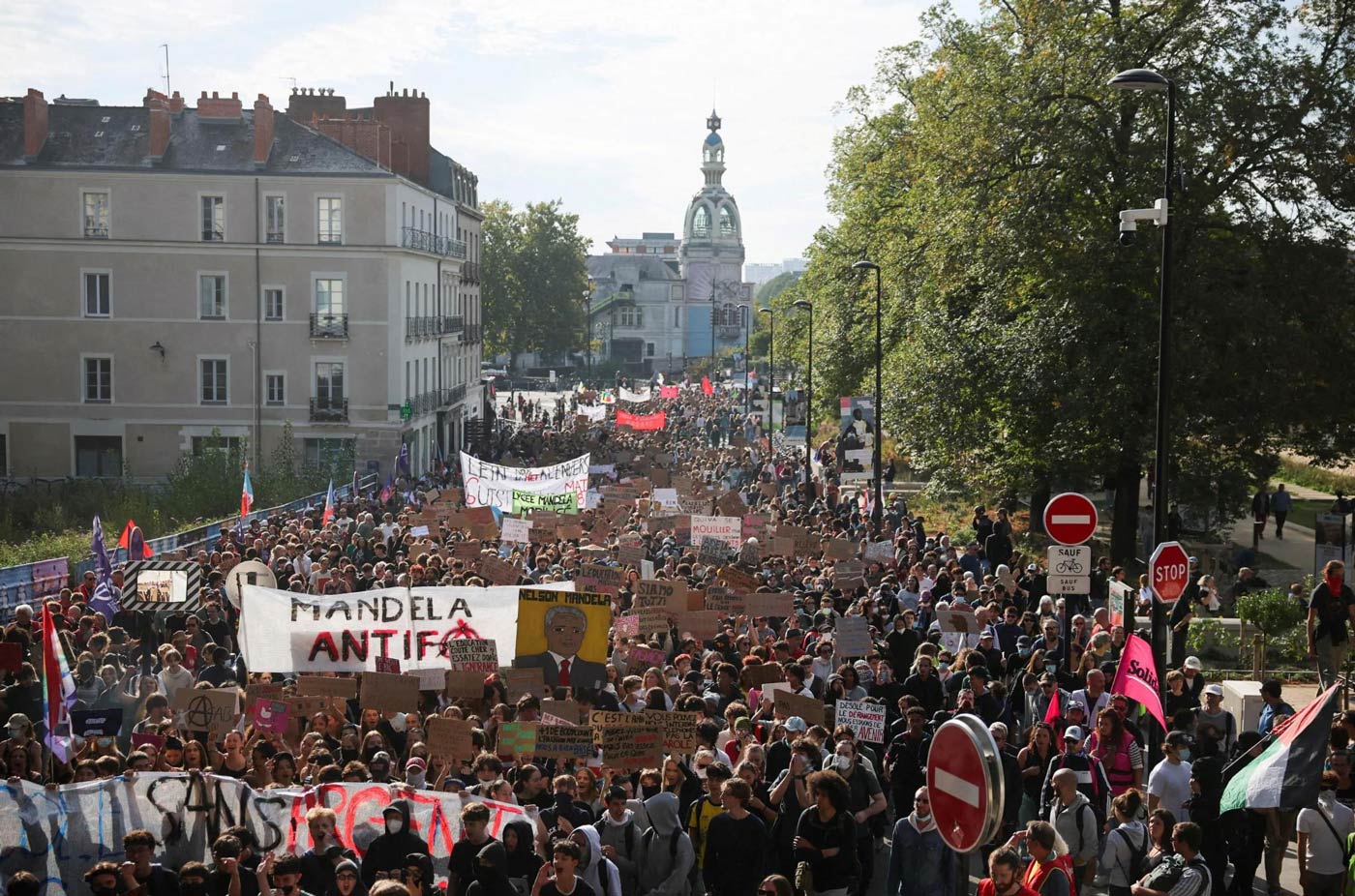
Thousands gather to protest police violence and support the students in revolt (Nantes, October 6, 2026)
This update on the student unrest in France picks up where we ended our previous report, on the eve of the national call to take the streets on October 6, 2026.
The stakes were high on this crucial day of action. It was critical to show massive solidarity with the high school students fighting like hell against the empty future looming on their horizon. The day presented an ideal opportunity to expand the scope of the current movement by joining forces to resist the authoritarian state power that has been growing stronger every day.
The following article provides further context and analysis to understand the current situation in France, along with reports on what went down in the streets over these last rebellious weeks.
Background: The Banlieues and the Enemy Within
When governments or powerful institutions feel threatened, they often strive to reaffirm their authority by inventing scapegoats to hold responsible for all supposed misfortunes. By invoking the menace of an “enemy within,” politicians can shift blame for systemic problems that have resulted from their own actions onto a specific category of individuals. In France, the most common targets are the residents of the banlieues, the impoverished suburbs on the outskirts of Paris and other cities.
At the beginning of the student blockades, the movement remained limited to a handful of high schools in these Parisian suburbs. In response, President Emmanuel Macron and his ministers decided to react quickly and do everything in their power to silence this emerging wave of youth protest. Due to the location of the first blockades, authorities believed that they could act more freely and repress the unrest with impunity, since these specific territories have been targeted for generations by all government administrations across political lines.
The condition of the banlieues, which remain populated by descendants of the French Empire’s colonized subjects, reflects France’s ongoing role as a neocolonial power that continues to exploit African territories. Consider the disastrous oil project in Uganda orchestrated by the France-based multinational company TotalEnergies, or the corruption case involving the French far-right business tycoon Vincent Bolloré and his bribery and money laundering schemes across West African ports.
French governments and corporations have no scruples about extracting enormous wealth from African countries. This neocolonial pillaging fuels France’s position as the seventh richest country in the world today, according to the IMF. Yet despite these astronomical profits, the nation refuses to address the problems facing its post-colonial population and their descendants within its national territory.
At the twilight of France’s colonial empire, decades of occupation and racist violence had created political and economic instability across northern and western Africa. As a result, waves of migrants began leaving their countries to come to France for work in the 1950s. Upon arriving, they continued to face systemic colonial racism, relegated to the economic margins and second-class citizenship. This cheap workforce ended up gathering on the outskirts of major cities, living in makeshift neighborhoods and slums like those of Nanterre on the western edges of Paris.
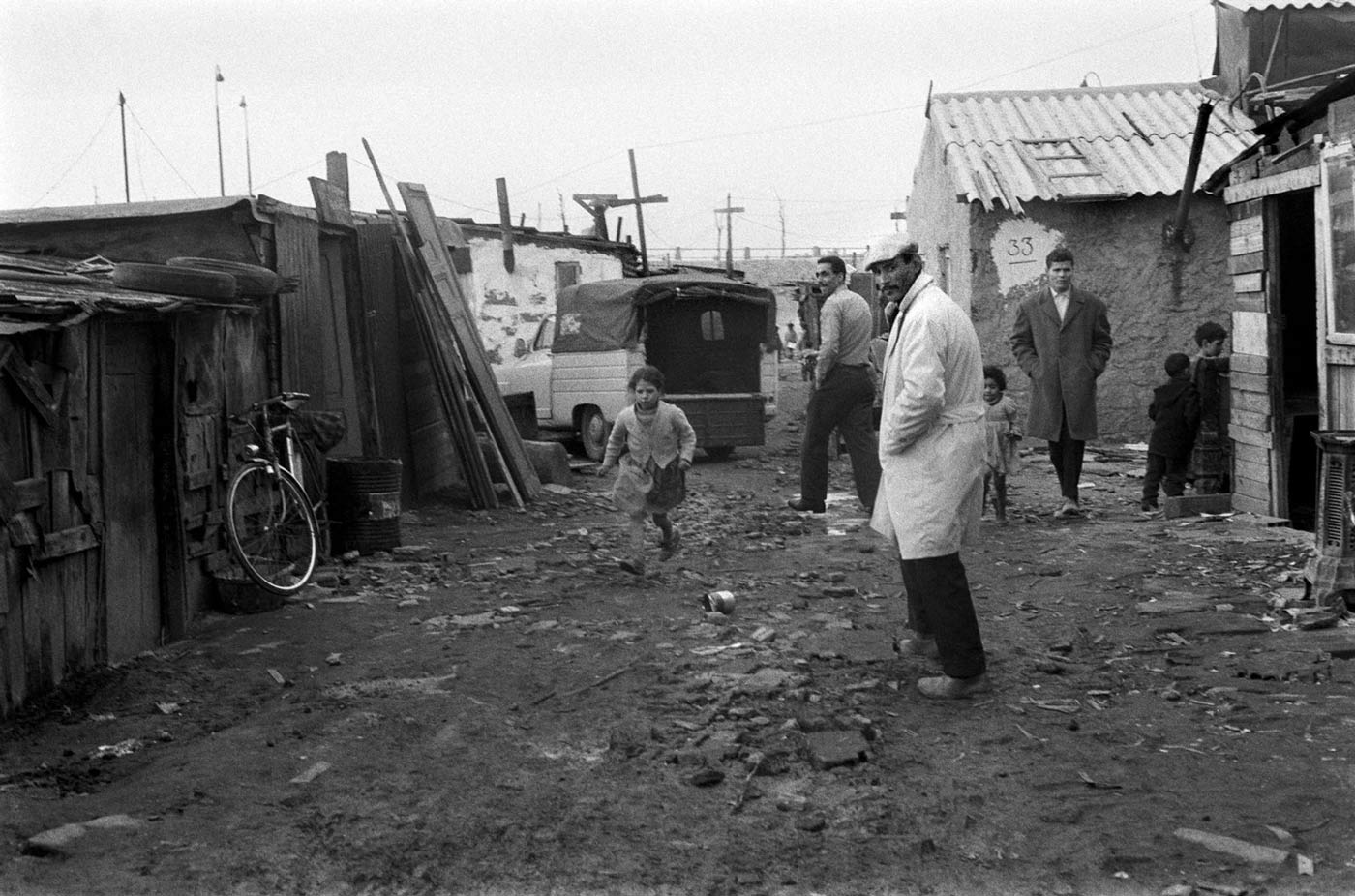
Shantytown in the Parisian suburb of Nanterre in the 1960s
Over the following decades, urban development projects replaced these slums with massive apartment blocks into which immigrant families and low-income workers were relocated. Today, these areas are known as the banlieues (the suburbs). In mainstream French political discourse, authorities and journalists invoke the banlieues as a derogatory term that embodies all the supposed flaws of our modern society.
The banlieues also offer areas of experimentation for law enforcement. Politicians ranging from moderate to reactionary have long considered these suburbs “lawless areas” whose young residents pose a threat to the ruling order. In response, the French state consistently harasses and represses these populations to instill fear and obedience and to force them to adapt to its laws. This targeted violence reproduces old colonial strategies within the territory of the nation. For example, the “state of emergency,” developed as legal tool in former French colonies for crowd control, was first used within the borders of France in the banlieues.
Past governments pushed law enforcement to increase the pressure in the suburbs, invoking the “war on drugs” and defense of their sacrosanct “democracy.” They invested in new weapons and equipment, which specific police units experimented with freely in the streets of the banlieues to test their usefulness in repressing popular mobilization. These racist police forces operate with impunity in these territories and consider every person they encounter a potential threat. As a result, numerous young people of color have been abused, injured, or killed at the hands of police, such as Zyed Benna and Bouna Traore in 2005, Adama Traoré in 2016, and more recently, Nahel Merzouk in 2023.
In the face of such contemptuous violence from the French state and its armed henchmen, it is inevitable that people would organize on a grassroot level to defend themselves and counterattack against these intolerable conditions. It is simply a question of dignity and survival. Historically, the banlieues have been the settings of intense riots and confrontations with police forces, often leading to massive property destruction and arsons.
In this context, it is not a coincidence that the student blockades first emerged in these suburbs, nor that the government decided without hesitation to send in heavily equipped police forces to repress them. This response is only a logical extension of the long legacy of colonial racism directed against part of the population. The French state continues to consider working-class people and the children of immigrants as the biggest threat to its stability. Therefore, to maintain its crumbling power structure by any means necessary, its solution is to constantly terrorize these youths to contain their rebellious energy.
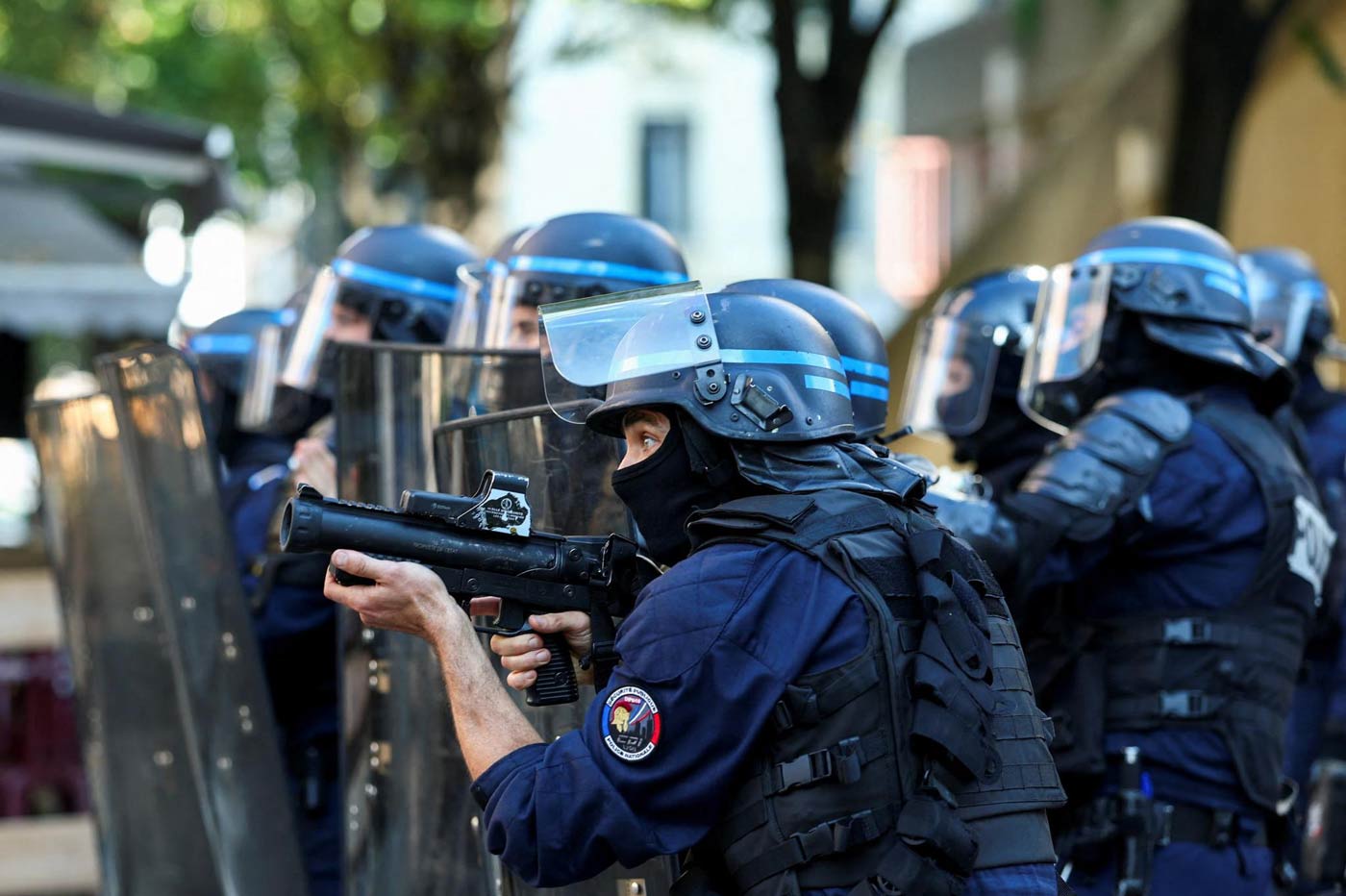
The repressive technologies used by police against students and protesters today were tested out on the populations of the banlieues (Lyon, October 6, 2026)
Keeping the Rage Alive
After more than a week of intense confrontations and blockades throughout France, it became clear that curbing the ungovernable student movement had become the number one priority of the current ruling order.
Nevertheless, the movement refused to be intimidated by the brutal repression implemented by authorities. Instead, it paid tribute in its own way to the Yellow Vest unrest that began in 2018 by rebranding its own key days of actions as “Acts.” This framework of successive mobilizations, each building on the last, maintained the pressure on politicians and law enforcement by providing regular opportunities to take the streets in massive demonstrations on a national scale.
While these national days of action appeared once or twice per week, this doesn’t mean that nothing happened the rest of the week. On the contrary, multiple forms of action—blockades, sit-ins, direct confrontations with police forces, property destruction, arsons, and more—continued to take place daily across multiple cities throughout France. This plurality of tactics, combined with the courage and determination of numerous teenagers throughout the past weeks, has enabled the unrest to last this long.
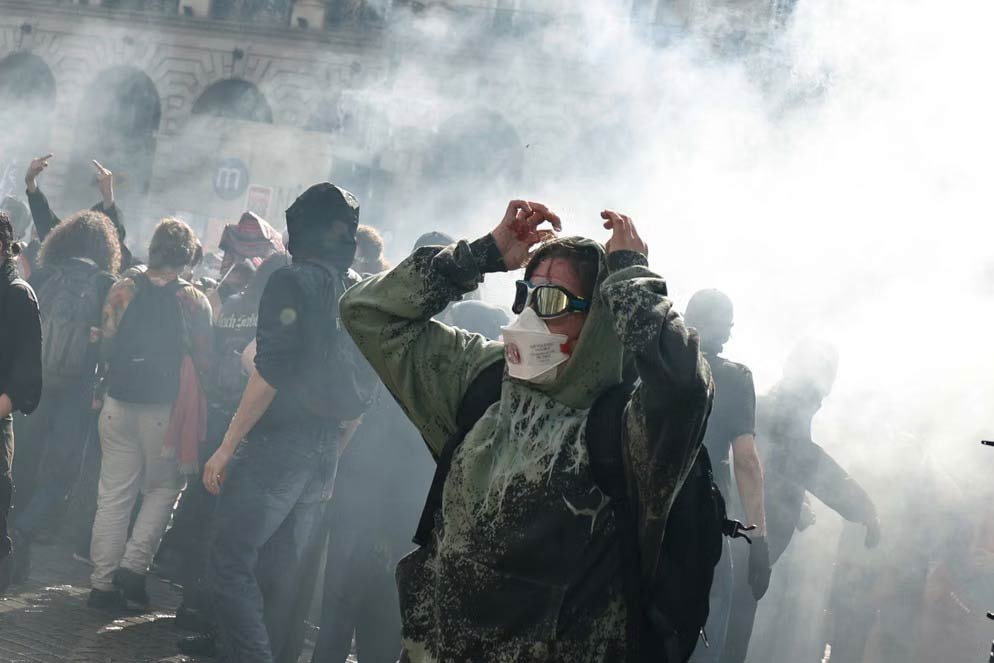
Clouds of tear gas in Rennes (October 6, 2026)
Act III: October 6, 2026
On the morning of Tuesday, October 6, students gathered in front of their high schools and universities to block access. This time, due to the state’s escalation of violence against the youth demonstrations over the previous days, parents and teachers decided to join the students and assembled with them in front of schools. Through their presence, they hoped to prevent intensifying repression from police forces.
For the most part, their strategy appears to have worked. Reports from different blockades during the morning mentioned that on the whole, tensions were not as high as on previous days. Nevertheless, some locations saw police officers attempting to break through the lines of some parents and teachers who were protecting students or using pepper-spray to disperse protesters.
It is difficult to confirm whether the less brutal state response that morning resulted from police reluctance due to the presence of adults among students, or from specific orders coming from government officials. After the increasing number of injuries inflicted on students over the preceding days, the government may have instructed its armed forces to be more careful while dealing with student blockades, especially with parents and teachers joining them.
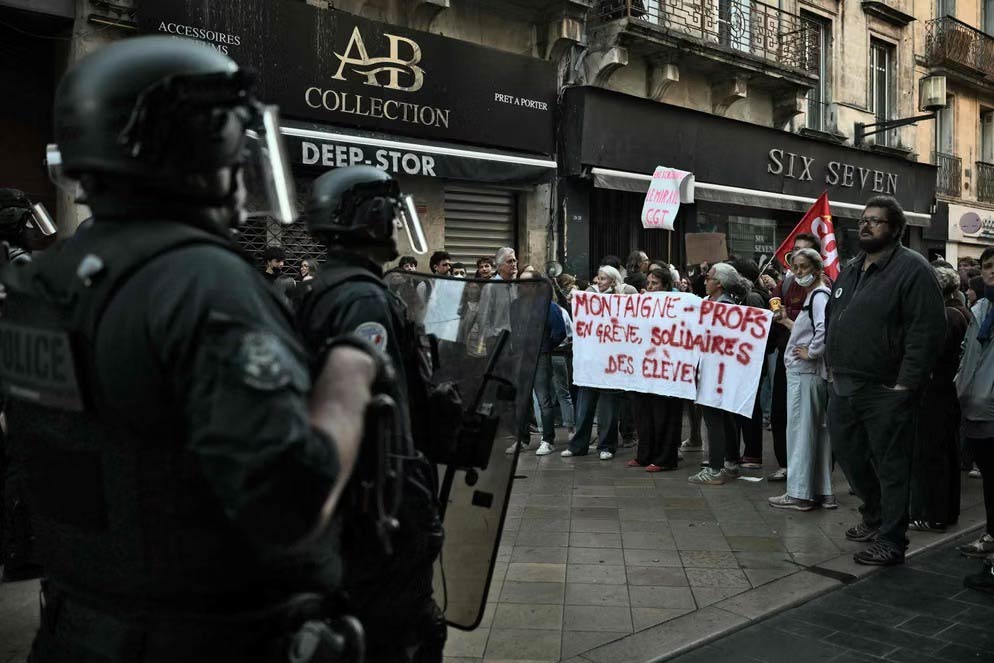
Parents and teachers on the front line to defend their children and students (Bordeaux, October 6, 2026)
While parents and teachers joining their students on the front lines during these morning actions may have discouraged a more violent response from the state, their presence in the blockades may also have helped authorities to regain some partial control in the streets. The presence of such authority figures can play a role in discouraging rebellious behavior among young people. In the days to come, the success of the unrest may depend in part on whether students can receive support from adults while maintaining their own autonomy and momentum.
That same morning, as the first demonstrations were taking place in Lille, Lyon, Marseille, Bordeaux, Nantes, and other cities, some university students blocked their campuses to join the movement. Around noon, as people converged at the Place de la République for the Paris demonstration, authorities announced that 891 of the country’s 3700 high schools were either partially or completely closed, including 250 just in the Paris region. Contrary to the official announcements made by the government, the movement was gaining rather than losing momentum.
The Paris demonstration was scheduled to depart from Place de la République in the direction of Place de la Nation. The 3.3-kilometer pathway connecting these two major squares in eastern Paris has frequently been the scene of social movement marches and intense clashes with police forces. This time, however, we learned beforehand that police units had received orders to keep their distance from demonstrators and to not be “visible” to prevent escalating tensions. The government appeared to have adapted its law enforcement strategy for the day in response to mounting criticisms of its repression of the students since the beginning of the movement.
Before the official departure time of the procession, the square was already so packed that thousands of demonstrators had begun walking down the boulevard towards La Nation to make space for more people to join. The flow of individuals passing through Place de la République seemed endless. Massive numbers of high school and university students, teachers and other educational workers were joined by leftist organizations, trade unions, and other supporters, as well as some radicals and anarchists. The feeling among the crowds was festive, impassioned, and full of determination.
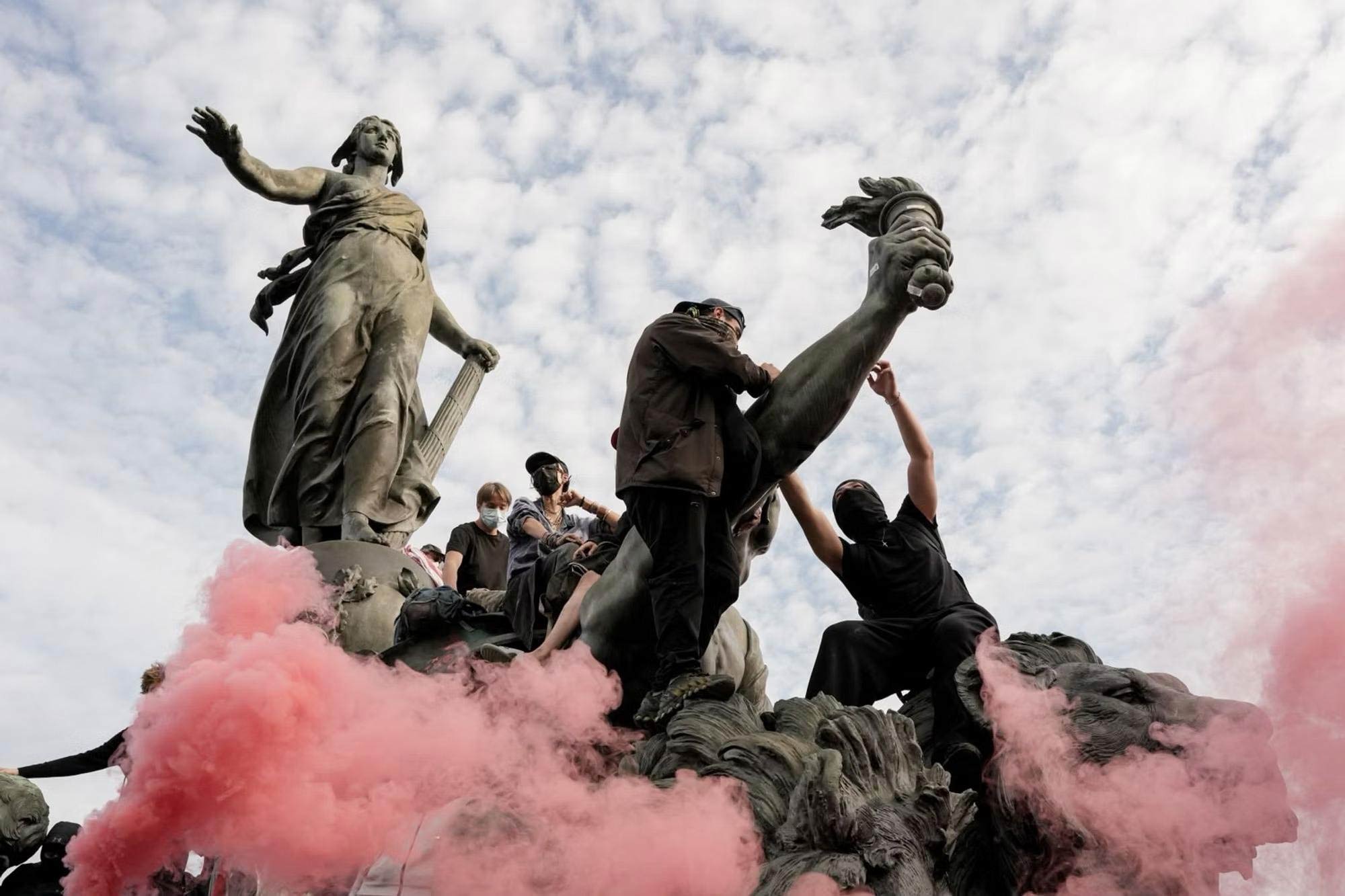
As the crowd approached Place de la Nation, the atmosphere gradually changed. Police units in riot gear were blocking adjacent streets preventing anyone from entering or exiting the procession. Marchers erected a makeshift barricade and set it ablaze in the middle of the boulevard, while several targets had their front windows smashed and their offices ransacked. After weeks of brutal attacks on the protesting students, this escalation of tactics reflected the justified rage and desire to take the offensive that many demonstrators felt.
At this point, intense confrontations with police forces began at Place de la Nation. Riot police and BRAV-M special units encountered showers of stones and projectiles thrown by courageous rioters, while the rest of the crowd of protesters that did not physically take part showed their support by chanting the classic “Tout le monde déteste la police” (“Everyone hates the police”) and shouting, “ACAB”.
Police forces used tear gas, stun grenades and rubber bullets to attempt to disperse the thick crowds entering La Nation. But people stayed, continuing to demonstrate and hanging out amid the joyful chaos. At times, officers charged demonstrators in order to snatch and arrest specific individuals, while determined individuals counterattacked them head-on and without respite. The solidarity experienced during these moments was a breath of fresh air among the thick clouds of tear gas.
At the end of the day, despite the false reassurances of the authorities in the mainstream media, the third national day of action was a clear victory for the movement. The objective of gathering masses of people in the streets to join forces with the students had been achieved. According to unions and organizations, at least 450,000 demonstrators participated across France, around one fourth in Paris. As usual, authorities announced much lower numbers, estimating around 250,000 total demonstrators. Moreover, to reassure the nation of its control over the situation, the government’s Ministry of the Interior announced that 488 individuals had been arrested during the day, raising the total of arrests since the beginning of the movement to an unprecedented number of 6547.
These figures illustrate the escalation of authoritarian law enforcement doctrine in France. By comparison, during the first 26 days of the Yellow Vest movement, French police recorded around 12,000 arrests, an average of 460 each day. Eight years later, these figures have been dramatically surpassed. As of October 6, 2026, approximately 935 arrests had taken place every single day since the beginning of the movement.
Despite these disturbing figures reflecting growing mass arrests, the student movement did not back down. Their persistence in the streets shows their determination to continue fighting, not only to improve the conditions in their schools but to challenge the living hell the French authorities are drawing tighter around us every day.
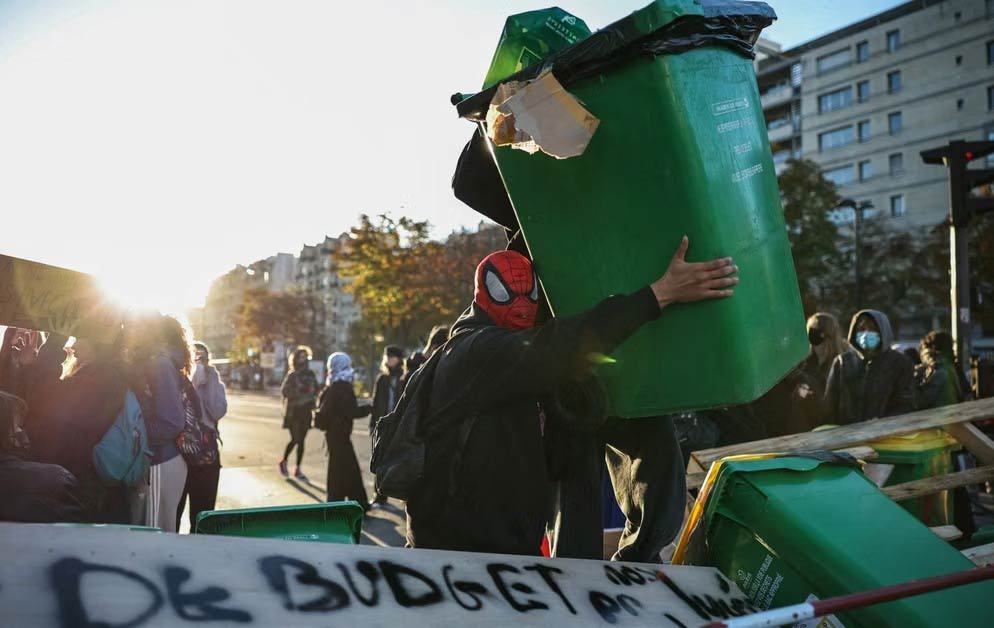
Students building a barricade in front of their high school (Paris, October 8, 2026)
Act IV: October 8, 2026
Two days after this impressive mobilization in the streets, student unions issued another call for mass convergence in the streets to maintain pressure on the government. As they had done for nearly two weeks, students from all over the country woke up early to meet in front of their schools, build makeshift barricades, and block the main entrances.
By 8:00 am, hundreds of high schools remained blocked in different cities. In the Paris region alone, about 145 schools were either closed, blocked or experiencing some sort of disruption. The Ministry of Education announced that 224 schools were completely closed and 151 partially closed. Authorities used these figures to once again claim that the movement was losing momentum, since “94% of high schools in France were completely or partially open” on this Thursday morning.
On this new day of action, a demonstration was scheduled to take place in Paris during the afternoon. However, the city’s Police Prefecture refused to approve the initial route requested by student unions. Instead, authorities only allowed students and protesters to converge and gather at Place de la Bastille, an ideal location for kettling large crowds of individuals by closing all access to the square.
Nevertheless, an estimated 25,000 students and other demonstrators gathered at La Bastille, while demonstrations also took place in Lille, Lyon, Marseille, Nantes, Rennes, Toulon, and other cities.
After several uneventful hours in the plaza, confusion began to spread among demonstrators, as no one knew where to leave the demonstration with police units holding their lines in front of every potential exit. The crowd simmered as people moved from one street to another seeking a way to escape from this trap.
Unsurprisingly, this stressful situation led to clashes with law enforcement. As the sun set, tensions between protesters and police escalated. To “clear the square,” police forces carried out repeated violent charges and shot tear gas canisters, rubber bullets, and sting ball grenades at demonstrators. Courageous rioters answered by shooting fireworks and throwing paving stones, glass bottles, and other projectiles. Authorities struggling to disperse the remaining protesters deployed a water cannon. Reports suggested that several individuals were injured in the clashes that afternoon. While the last groups of demonstrators were still resisting police attacks at La Bastille and in the nearby streets, other demonstrators attempted to regroup at Place de la Nation, but were rapidly surrounded by officers.
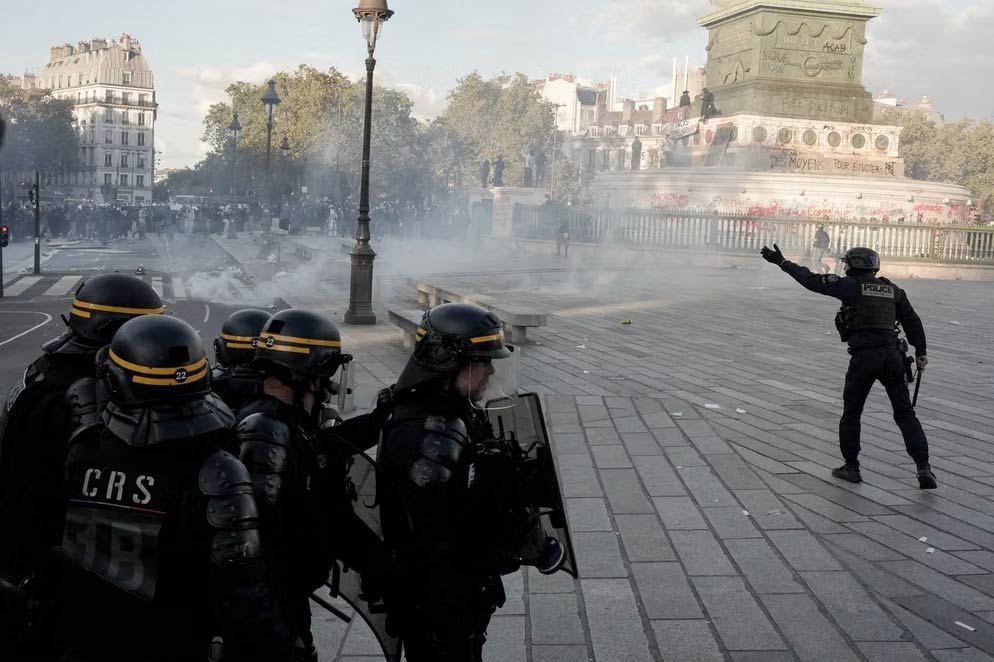
Riot police units attempt to clear out La Bastille (Paris, October 8, 2026)
At the end of the day, the government announced that 71,500 people had participated in the afternoon demonstrations across the country, including 25,000 in Paris. 55,000 took part in actions in front of high schools, of whom only some joined the afternoon processions and gatherings. Officials reported 504 arrests on October 8.
But government statistics should be interpreted with extreme caution. For example, authorities claimed that since the beginning of the movement on September 17, 215 students, 85 teachers and education staff members, and 800 police officers had been injured. These figures seem dubious, given the unlikelihood that heavily equipped police officers would receive injuries at far higher rates than mostly unarmed high school students and other protesters. As always during protest movements, the war of numbers offers authorities a useful tool to build their narrative and justify their actions.
Repressions and Concessions: The State Tries to Undermine Solidarity
In the face of this increasing wave of solidarity with students and boiling anger against government inaction and police violence, the Macron administration desperately attempted to keep up appearances while deploying strategies to divide the movement and regain control.
During a speech to the National Assembly on October 6, Prime Minister Sebastien Lecornu reiterated the need to deploy large numbers of law enforcement officers in the streets to counter the “violence” spread by the student movement. This shows the government’s willingness to legitimize the use of brutal force against the nation’s teenagers without second-guessing its policies or even admitting the existence of “police violence”.
All sorts of media outlets have widely reported how students have been insulted, assaulted, brutalized, and injured by police forces since the beginning of the movement. In response, Interior Minister Laurent Nuñez stated that law enforcement actions have been carried out with “the utmost proportionality” and that he refused to apologize for any of the state’s actions since the emergence of the movement.
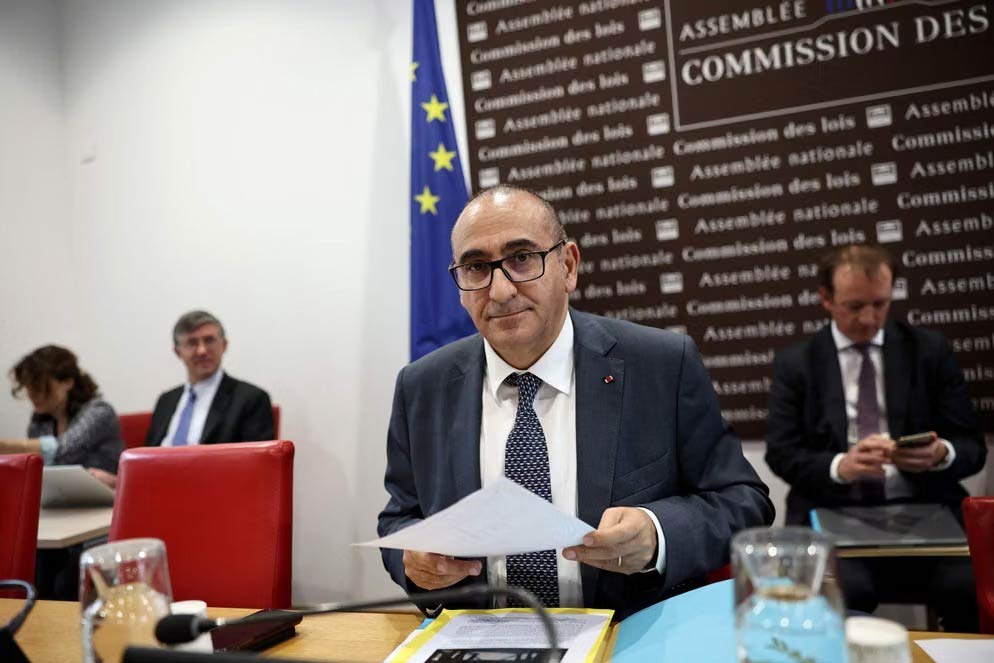
Interior Minister Laurent Nuñez, who is in charge of the management of public order in response to the students protest movement (Paris, October 7, 2026)
In the same breath, without a hint of shame for its glaring hypocrisy, the government also announced that the use of stun grenades by police against the student movement would be suspended until further notice, following the tragic loss of a hand by young protestor on October 5. Such decisions refute the government’s own narrative of “proportionality,” as they are well aware that they are targeting teenagers with military weapons intended to cause physical or mental injury, if not death. This hypocrisy, while not surprising, remains infuriating.
Hoping to divert attention from the protestors’ demands, the government also announced its decision to accelerate discussions regarding the voting of a bill named “casseurs-payeurs.” This new repressive measure was first proposed last May in the aftermath of the riots and lootings that followed the victory of the PSG (the Parisian football team) during the final game of the Champions League. Its aim is simple: to make the families of suspected rioters pay for damages they allegedly caused. This law, a favorite proposal of the extreme right for years, would force any individual who knowingly took part in a group that committed violence, theft, or damage to pay up to 10,000€ [over $11,000] each towards repairs.
But the law goes beyond restitution into criminalizing participation in nearly any public resistance. Authorities will not have to prove that a specific individual broke anything; simply belonging to a group of “rioters” will suffice to find someone guilty. Any time a person decides to remain in the streets after police ordered a crowd to disperse, they would become “co-responsible” for whatever happens next. For minors, their parents would have to pay the actions of their children. And to make sure money can be extracted from the rebellious poor, the law allows authorities to garnish money directly from potential housing benefits and family allowances. In short, this law once again targets low-income individuals and families perceived as threats to the ruling order, as well as anyone who would dare to defy authority.
Beyond these repressive measures, the government also scrambled to find “solutions”—i.e., distractions—to end the crisis. During his speech, Lecornu also insisted that the government, via the Ministry of Education, had implemented tools for high school students to take part in some sort of national survey where they can express their frustrations and make requests to improve the educational system. Such strategy of watered-down participatory democracy was also used during the Yellow Vest movement to divide demonstrators and weaken their collective force. First, the French government represses students in cold blood; then it asks them for “constructive” dialogue.
Lecornu explained that by the end of the month, the government would study and work to address all the demands received by students via their official platforms to provide concrete solutions to the current crisis in the educational system. He also promised to improve “ParcourSup,” the online platform with which students list their “wishes” and apply to different post-secondary education options. He also announced that until the end of the week, each high school has been asked by the Ministry of Education to cancel half a day of classes in order to create some space and time for “a period of internal democracy” during which students and teachers could exchange about what should be changed within the school. This isn’t the first time that the language of “democracy” has been used as a tool for counterinsurgency.
Similarly, on October 8 Education Minister Édouard Geffray made a new promise to provide 3000 extra teachers, while welcoming student unions and organizations to contribute their views on the current situation in hopes of reaching a political agreement to end the demonstrations as soon as possible. These promises and calls for dialogue show the Macron government’s strategy to pacify the situation by partially answering some of the main demands made by the student movement—while ratcheting up repression in the streets to maintain power on their own terms.
National media have reported that tens of thousands of demands were already made by students through these official platforms. Nonetheless, it seems to us that, so far, doing so has not stopped them from continuing to be present in the streets. Even students who may participate in such official channels recognize that their collective power to disrupt the status quo, not the government’s pacifying gestures, remains the source of their genuine power and voice.
So far, the student movement has resisted cooptation by political opportunists and trade unions. However, its success and widespread public support render it a tempting target for those who would attempt to control it or hitch it to other agendas. University student unions and their spokespeople form part of the movement, and some leftist politicians and their followers actively support it. However, none of them have yet been able to speak on behalf of all its participants, nor to control the diversity of tactics that have flourished within it.
Finally, the existing solidarity within the ranks of students is admirable. As we reported previously, teenagers face vastly different realities depending on the geographical areas where they live and study. The claim of the French school system to promote equal opportunity and reward merit rather than class and geographic background is simply a lie, in the face of the structural inequalities that flourish within capitalism and the educational system designed to reinforce it. Nevertheless, while high-school students in the suburbs were facing violent repression from police forces, students from wealthier districts and prestigious universities joined the struggle by blocking or occupying their schools in solidarity. Numerous students explained that although they are well aware that they do not experience the same difficulties as their counterparts living in the banlieues, they could not remain passive in the face of such police violence and injustice against their counterparts.
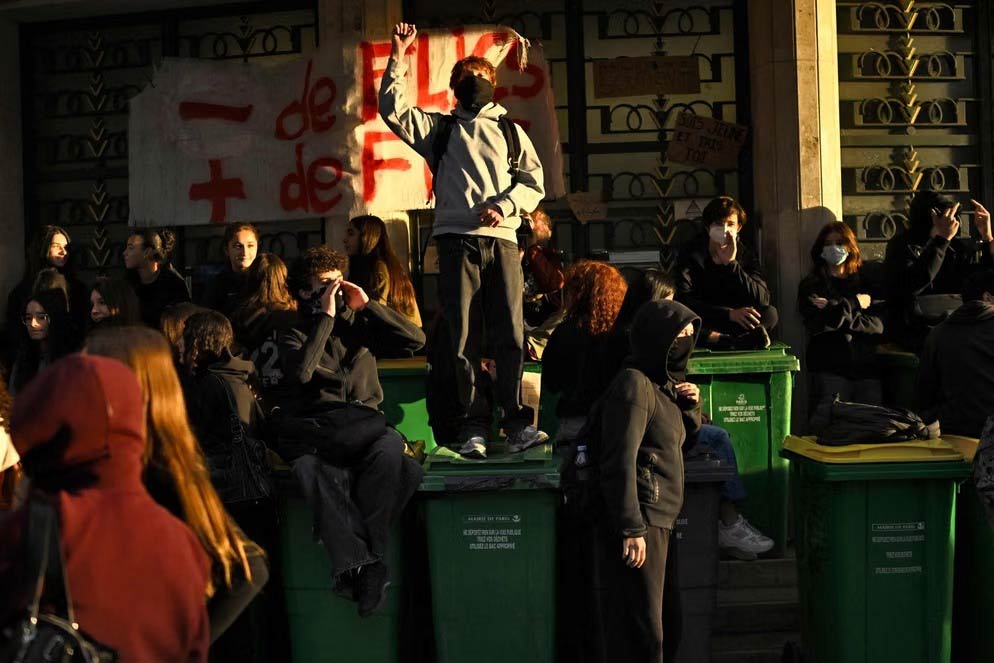
Students blocking the Hélène-Boucher high school. The sign reads: “Fewer cops, more money.” (Paris, October 6, 2026)
Onward Together Against Their World
Following another intense week of actions and protests, the Ministry of Justice announced on Friday, October 9 that since the beginning of the movement, more than 6800 people have been taken into custody, 86% of whom are minors. So far, 21 individuals have been held in jail while awaiting trial.
At the eve of a new weekend, the government continued to promote the narrative that the movement was declining and the situation was progressively coming back under control, trumpeting the decreasing number of blocked high schools as evidence. But despite the mainstream media’s faithful adherence to this story, students remained unsatisfied by the government’s response and determined not to give up the fight. Far from feeling defeated, they issued a new call to take to the streets on Tuesday, October 13.
Act V: October 13, 2026
As the next day of action dawned, blockades and clashes with law enforcement forced the closure of about 200 high schools. Over the previous days, that number had held steady, showing that a significant core of high school students remained willing to fight for what they think is right.
But what changed dramatically on this day compared to the previous acts is that a large number of universities decided to join the movement all at once. Around noon, the organization Union étudiante announced to the media that 90% of the seventy French universities were blocked or completely closed. This massive involvement of university students during the fifth act of the student unrest would prove to be a critical development.
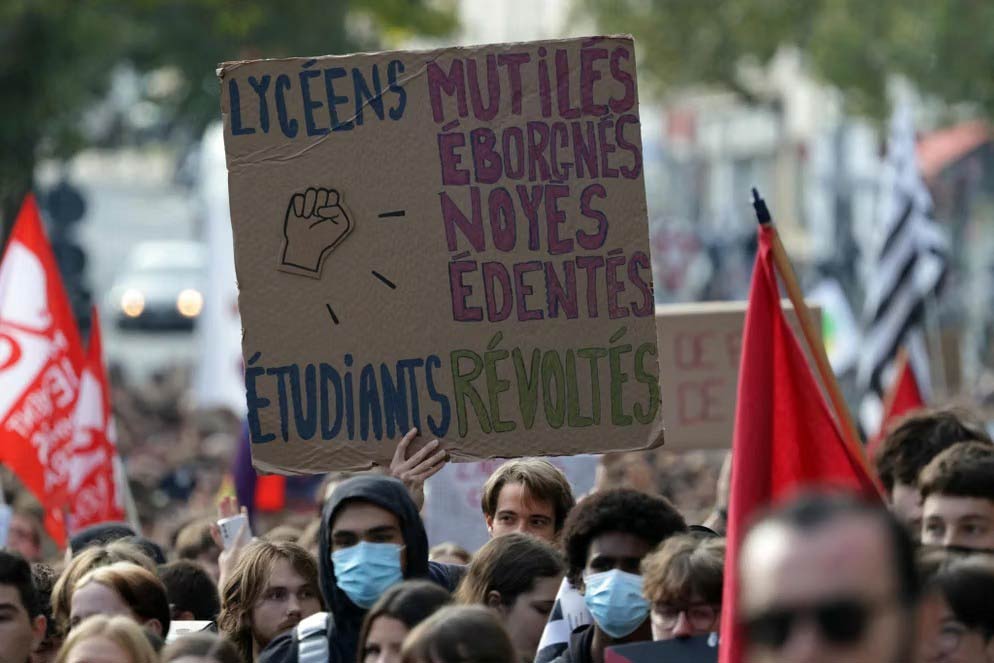
The sign reads: “High-school students maimed, shot in the eye, drowned, or toothless. University students outraged.” (Rennes, October 6, 2026)
As the movement expanded and gained in strength, the counterrevolutionary backlash against it from both the government and the grassroots extreme right increased in turn. The growing number of blockades at universities over these days led to a surge in fascist attacks intended to intimidate protesters in cities such as Paris and Lille.
As usual, the first marches throughout France took place in the morning. In Paris, the official demonstration was announced for 2:00 pm. This time, the itinerary validated by authorities changed from the classic Place de la République to La Nation. Demonstrators would be storming the southern and western parts of the city, departing from Place d’Italie and reaching Invalides, not far from the Ministry of Education and Matignon, the official residence of the Prime Minister. This route evoked sweet memories from another famous student movement that took place in France 20 years ago, during which intense riots took place once demonstrators reached Invalides. Another unofficial call went out summoning protestors to meet in front of City Hall. This unauthorized procession was finally granted the right to walk through the streets of Paris to reach its destination not far from the other demonstration.
On the afternoon of the 13th, police forces changed their tactics and drew up very close to the demonstrators, moving at the front of the procession. Before participants could join the march, they were subject to search by the police. Officers attempted to confiscate as many anti-police signs as possible. However, this strategy to muzzle public opinion against the police’s violent behavior proved unsuccessful, as thousands of protesters took pleasure in chanting the classic anti-police slogans in unison during the march.
As demonstrators approached their final destination, tensions with law enforcement escalated. Near Invalides, some motivated protesters attempted to continue their afternoon march towards Matignon, but were quickly stopped and pushed back by lines of police near Place Vauban.
It was here that intense confrontations unfolded over the next several hours. Police deployed water cannons and blanketed the square with tear gas in order to disperse the crowd. What demonstrators didn’t know yet was that other police units had surrounded them and stood ready to kettle them if needed in order to arrest specific individuals. During the clashes, rioters set a BMW SUV on fire and looted a nearby wine store.
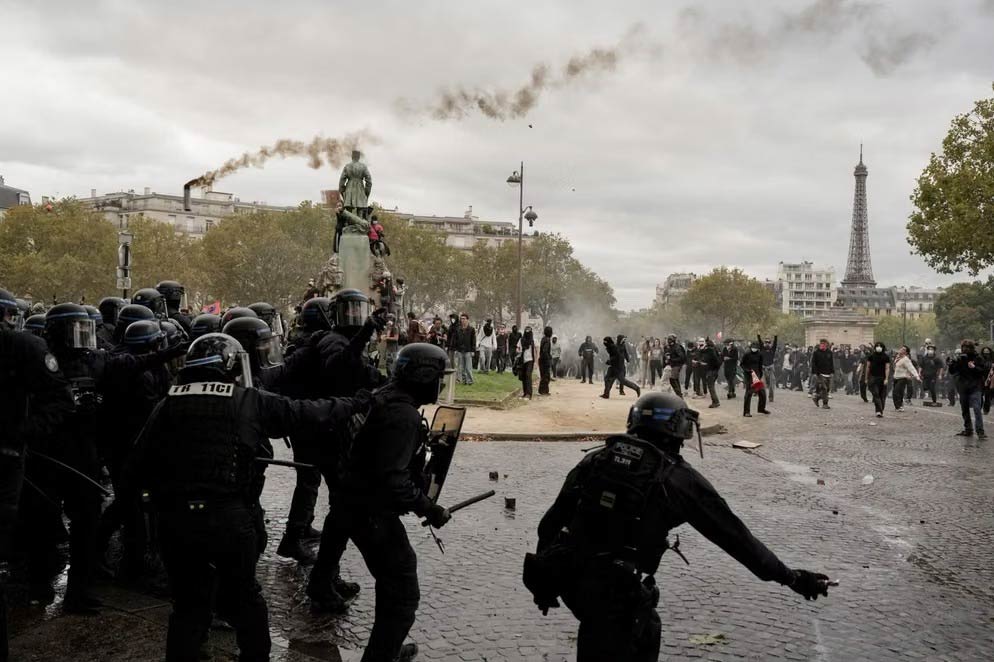
Street confrontations at Place Vauban (Paris, October 13, 2026)
Later that night, the government stated that 161,500 people demonstrated during the fifth act of the student movement, while the student unions claimed a total turnout of 480,000. Officials estimated 41,500 demonstrators in Paris. Further demonstrations took place in Nantes, Lens, Strasbourg, Bordeaux, Marseille and Lyon, where some confrontations with police forces and property destruction took place towards the end of the march.
By the end of the day, arrest figures had shot up further. 7950 individuals had been taken into police custody since the beginning of the student protests, 85% of whom were minors. To date, 2735 criminal cases had been filed, 2190 of which involved minors, and 26 individuals were placed in pretrial detention, including 9 minors.
Looking Forward: Will the Unrest Survive the Holidays?
As the first school holidays of the year approached, many students wondered whether their month-long mobilization would survive the two-week break from classes. Their worries were understandable; it is well known that holidays have often taken the wind out of the sails of many social movements, in France and beyond.
This is why, for days, high-school students have continuously called to take the street on Saturday, October 17, 2026. This call, massively shared online for weeks, suggests a resurgence of the Yellow Vest movement that launched in 2018. Rebellious high schoolers hoped that university students, Yellow Vesters, and other angry protesters would be able to merge with the movement to expand this social and political unrest in new directions.
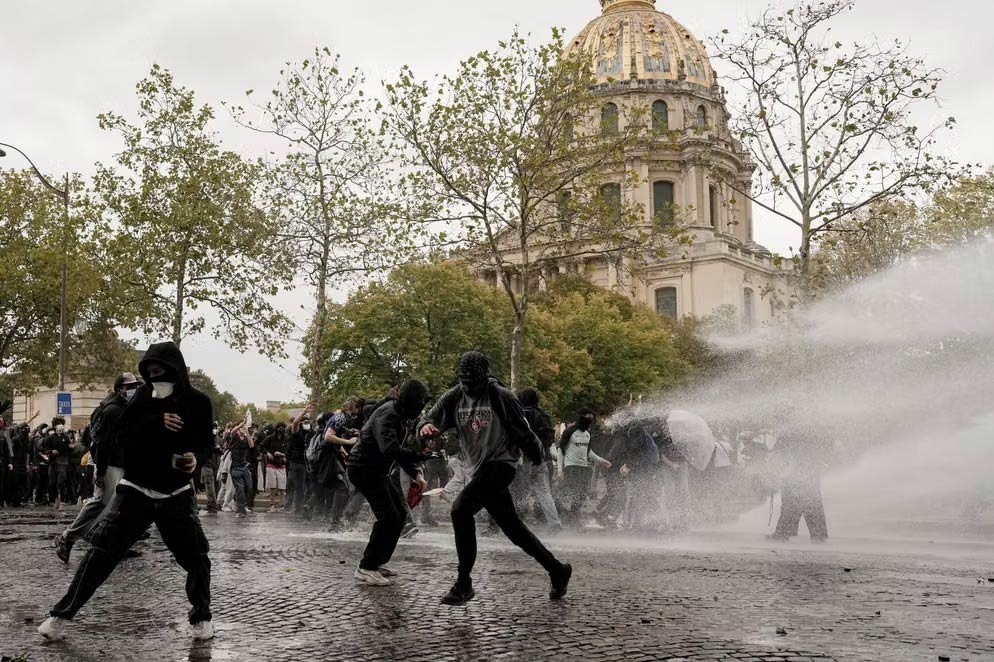
We haven’t been defeated yet. (Paris, October 13, 2026)
Meanwhile, the government continued to find itself in a bind over the crisis, despite its pathetic attempts to defuse the uproar through dialogue with student unions and organizations. After weeks of insisting that the movement was losing steam, now they are acknowledging that the level of militancy and determination coming from protesters has progressively increased over the previous days of action. They feared the potential outcome of the October 17 demonstrations—and as we have seen, their fears were justified.
With the fateful date approaching and tension building, important questions remained. Will other demographics decide to join the movement by also revolting against the government and their current living conditions, as authorities fear? Will we live up to the expectations of high school students and the courageous precedent they have set? Will we be able to unleash hell?
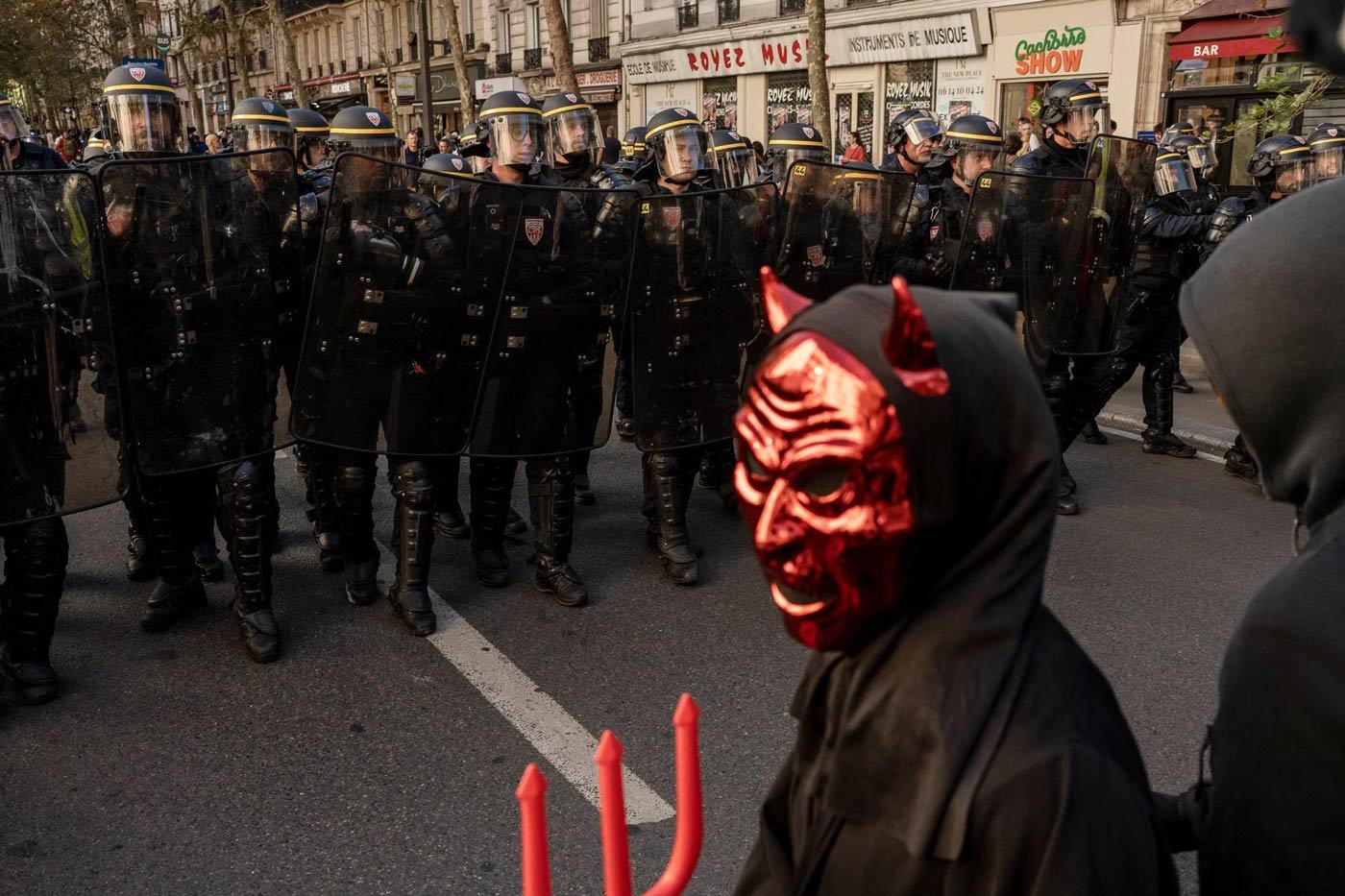
Will the student movement be able to unleash hell? (Paris, October 6, 2026).